

The right type of family therapy depends on the challenges your family is experiencing, how family members communicate, and what you want to improve.
Some approaches focus on communication. Others explore family roles, emotional patterns, behaviour, parenting, or past experiences. A therapist may also combine several methods based on your family’s needs.
Family therapy is not about blaming one person. It is about understanding how the family functions as a whole and creating healthier ways to communicate, solve problems, and support one another.

What Is Family Therapy?
Family therapy is a form of counselling that helps family members improve relationships, resolve conflict, and understand recurring emotional or behavioural patterns.
Sessions may involve:
✓ Parents and children
✓ Adult siblings
✓ Couples with children
✓ Blended families
✓ Extended family members
✓ One family member when others cannot attend
The therapist helps each person feel heard while identifying patterns that may be contributing to tension.
Family therapy can be helpful during major life changes, ongoing disagreements, parenting challenges, emotional difficulties, or periods when the family feels disconnected.
What Does Family Therapy Help With?
Families seek therapy for many different reasons.
| Family Challenge | How Therapy May Help |
| Frequent arguments | Improve communication and conflict resolution |
| Parenting disagreements | Create a more consistent approach |
| Behavioural concerns | Understand triggers and family responses |
| Separation or divorce | Support adjustment and reduce tension |
| Blended-family challenges | Clarify roles and expectations |
| Grief or loss | Process emotions together |
| Mental health concerns | Improve understanding and family support |
| Emotional distance | Rebuild trust and connection |
The most effective approach depends on the family’s goals, history, and current circumstances.
1. Structural Family Therapy
Structural family therapies focus on how a family is organized.
Every family develops roles, boundaries, routines, and patterns. Some structures work well, while others may create tension or confusion.
For example, problems may arise when:
- Parent and child boundaries become unclear
- One parent carries all the responsibility
- Children become involved in adult conflicts
- Family roles are rigid or unbalanced
- One family member feels excluded
The therapist helps the family identify unhealthy structures and develop clearer, more supportive relationships.
Structural family therapy may be helpful for:
✓ Parenting challenges
✓ Blended families
✓ Boundary problems
✓ Repeated power struggles
✓ Families with unclear roles
2. Strategic Family Therapy
Strategic family therapy focuses on specific problems and practical changes.
Rather than exploring every detail of the family’s history, the therapist looks closely at the current pattern surrounding a problem.
The family may be given exercises or tasks to practise between sessions.
For example, a therapist might help family members change how they respond during arguments or create a new routine around a recurring source of conflict.
Strategic family therapy may be helpful for:
✓ Repeated arguments
✓ Behavioural concerns
✓ Communication breakdowns
✓ Parenting conflicts
✓ Problems that follow a predictable pattern
This approach is often direct, goal-focused, and centred on measurable change.
3. Systemic Family Therapy
Systemic family therapy views the family as an interconnected system.
When one family member changes, the rest of the family may also be affected. A problem that appears to belong to one person may be connected to broader communication patterns, expectations, or relationships.
The therapist explores how family members influence one another.
Rather than asking, “Who is causing the problem?” systemic therapy asks, “What pattern keeps this problem going?”
Systemic family therapy may be helpful for:
✓ Complex family dynamics
✓ Long-standing conflict
✓ Emotional disconnection
✓ Multi-generational patterns
✓ Situations where one person is being blamed
This approach can help families move away from blame and toward shared understanding.
4. Cognitive Behavioural Family Therapy
Cognitive behavioural family therapy examines how thoughts, emotions, and behaviours affect family relationships.
Family members learn to recognize unhelpful thinking patterns and replace them with healthier responses.
For example:
✗ “They never listen to me.”
✗ “Nothing will ever change.”
✗ “They are doing this on purpose.”
These thoughts may increase frustration and lead to stronger emotional reactions.
Therapy helps family members slow down, challenge assumptions, and communicate more clearly.
Cognitive behavioural family therapy may be helpful for:
✓ Anxiety
✓ Depression
✓ Anger
✓ Behavioural concerns
✓ Negative communication patterns
✓ Problem-solving difficulties
This approach often includes practical skills and exercises that family members can use outside therapy.
5. Bowen Family Systems Therapy
Bowen family systems therapy explores how emotional patterns can pass from one generation to another.
Families often repeat familiar ways of communicating, handling conflict, expressing emotion, or responding to stress.
These patterns may continue even when family members do not consciously choose them.
The therapist may help clients understand:
- Multi-generational relationship patterns
- Emotional cut-offs
- Family alliances
- Repeated conflict styles
- Difficulty separating personal emotions from family pressure
Bowen family systems therapy may be helpful for:
✓ Adult family conflict
✓ Parent-child tension
✓ Multi-generational issues
✓ Emotional reactivity
✓ Repeating family patterns
Sometimes one person can begin this work individually, even when other family members are not available.
6. Narrative Family Therapy
Narrative family therapy helps families examine the stories they tell about themselves and one another.
Over time, family members may begin using fixed labels such as:
✗ “He is the difficult one.”
✗ “She is too emotional.”
✗ “We are a dysfunctional family.”
✗ “Nothing ever works for us.”
These labels can make problems feel permanent.
Narrative therapy separates the person from the problem. Instead of defining someone by a challenge, the family explores how the problem affects everyone and how they can respond differently.
Narrative family therapy may be helpful for:
✓ Negative family labels
✓ Low confidence
✓ Shame or blame
✓ Identity struggles
✓ Families feeling stuck in old stories
This approach can help families recognize strengths that have been overshadowed by ongoing conflict.
7. Emotionally Focused Family Therapy
Emotionally focused family therapy explores the emotions underneath conflict.
Anger, withdrawal, criticism, or defensiveness may be protecting deeper feelings such as fear, hurt, rejection, or loneliness.
A therapist helps family members express these emotions in safer and clearer ways.
Emotionally focused family therapy may be helpful for:
✓ Emotional distance
✓ Parent-child disconnection
✓ Trust concerns
✓ Repeated criticism and withdrawal
✓ Difficulty expressing vulnerability
The goal is to create stronger emotional security and connection within the family.
8. Solution-Focused Family Therapy
Solution-focused family therapy emphasizes goals, strengths, and practical progress.
The therapist spends less time examining the full history of the problem and more time identifying what the family wants to change.
Questions may include:
- What would improve if therapy worked?
- When does the problem happen less often?
- What is already going well?
- What small change could the family make this week?
Solution-focused family therapy may be helpful for:
✓ Families wanting practical strategies
✓ Short-term goals
✓ Communication improvements
✓ Routine or parenting challenges
✓ Families who feel overwhelmed by the problem
This approach helps families build on existing strengths instead of focusing only on what is going wrong.
How Do the Types of Family Therapy Compare?
| Therapy Type | Main Focus | Often Helpful For |
| Structural | Roles and boundaries | Parenting, blended families, power struggles |
| Strategic | Specific problem patterns | Behaviour and recurring conflict |
| Systemic | Family interactions | Complex or long-term dynamics |
| Cognitive behavioural | Thoughts and behaviours | Anxiety, anger, negative communication |
| Bowen family systems | Generational patterns | Adult family and parent-child concerns |
| Narrative | Family stories and labels | Shame, blame, identity concerns |
| Emotionally focused | Emotional connection | Distance, trust, attachment |
| Solution-focused | Goals and strengths | Practical and short-term improvement |
There is no single approach that is best for every family.
Which Type of Family Therapy Is Right for You?
The right approach depends on what your family is experiencing.
Structural therapy may be suitable if:
- Boundaries are unclear
- Parents disagree about authority
- Family roles feel unbalanced
Strategic therapy may be suitable if:
- The same problem keeps repeating
- You want practical changes
- Behaviour is a major concern
Systemic therapy may be suitable if:
- The problem involves several relationships
- One person is being blamed
- The family feels trapped in a pattern
Cognitive behavioural therapy may be suitable if:
- Negative thoughts lead to conflict
- Anxiety, anger, or depression affects the family
- You want practical coping tools
Emotionally focused therapy may be suitable if:
- Family members feel disconnected
- Conflict hides deeper hurt
- Trust and emotional safety need improvement
A therapist can recommend the most appropriate approach after learning more about your family.
Can a Therapist Combine Different Approaches?
Yes. Many therapists use an integrative approach.
This means they draw from several therapy models rather than using only one.
For example, a therapist may:
✓ Use structural therapy to clarify family boundaries
✓ Add cognitive behavioural tools for emotional regulation
✓ Use emotionally focused techniques to rebuild connection
✓ Apply solution-focused strategies to create short-term goals
Combining approaches allows therapy to be adapted to the family rather than forcing every family into the same method.
What Happens During Family Therapy?
The first sessions usually focus on understanding the family’s concerns, relationships, and goals.
The therapist may ask:
- What brought the family to therapy?
- When did the problem begin?
- How does each person experience the situation?
- What has already been tried?
- What would a healthier family relationship look like?
Future sessions may focus on communication exercises, emotional awareness, boundaries, problem-solving, or new family routines.
The therapist does not take sides. Their role is to help the family understand the complete pattern and move toward healthier interactions.
Do All Family Members Need to Attend?
Not always.
Therapy may begin with the whole family, several family members, or one person.
The best arrangement depends on:
✓ The family’s goals
✓ Who is willing to attend
✓ The ages of the children
✓ The nature of the conflict
✓ Whether joint sessions feel emotionally safe
Even when one family member begins therapy alone, changes in how that person communicates and responds may affect the broader family dynamic.
How Long Does Family Therapy Take?
The length of family therapy varies.
Some families need support for a specific short-term issue. Others are addressing long-standing patterns that require more time.
The timeline may depend on:
- The complexity of the problem
- How long the pattern has existed
- How many family members are involved
- Attendance and participation
- The family’s goals
- Whether additional individual support is needed
Progress is usually reviewed throughout therapy so the plan can be adjusted.
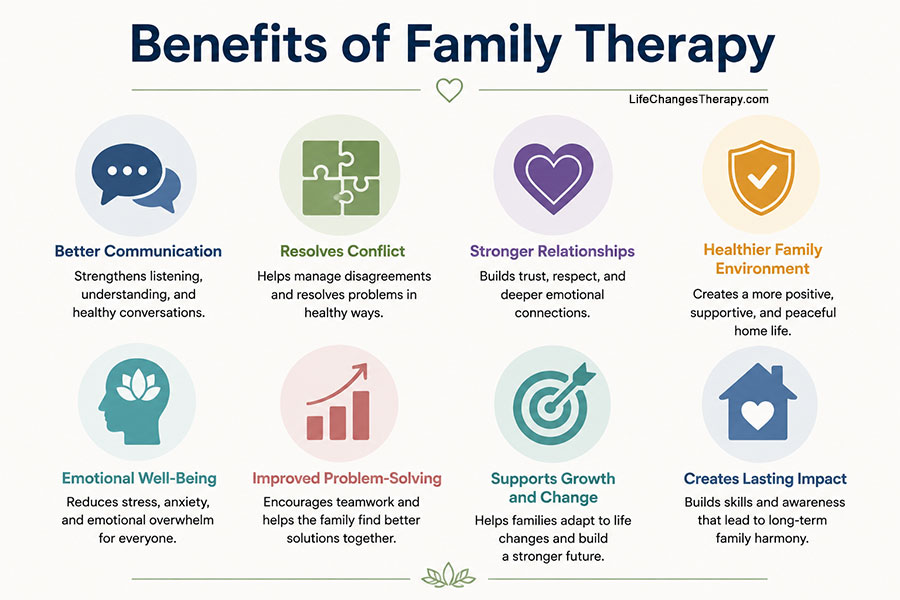
Benefits of Family Therapy
Family therapy can help create meaningful improvements across the household.
| Benefit | Potential Result |
| Better communication | Fewer misunderstandings |
| Clearer boundaries | Healthier family roles |
| Improved problem-solving | Less repeated conflict |
| Greater emotional awareness | More empathy and understanding |
| Stronger parenting alignment | More consistent expectations |
| Increased connection | Greater trust and family support |
The goal is not to create a family that never disagrees. It is to help family members handle differences in healthier ways.
Common Myths About Family Therapy
Myth: The therapist will decide who is wrong.
Reality: Family therapy focuses on patterns and relationships rather than assigning blame.
Myth: Only dysfunctional families need therapy.
Reality: Families seek therapy for communication, transitions, parenting, grief, and many common life challenges.
Myth: Everyone must agree before therapy can begin.
Reality: Therapy can sometimes begin with the family members who are ready to participate.
Myth: Family therapy is only for young children and parents.
Reality: It can support adult children, siblings, couples, blended families, and extended relatives.
Why Choose Life Changes Therapy?
Life Changes Therapy provides supportive family therapy in Mississauga for families experiencing conflict, communication difficulties, emotional distance, parenting concerns, and major life changes.
Therapy is personalized around each family’s needs rather than using a one-size-fits-all approach.
The focus is on helping family members:
✓ Feel heard and understood
✓ Communicate more effectively
✓ Resolve conflict respectfully
✓ Develop healthier boundaries
✓ Strengthen trust and connection
A thoughtful and non-judgmental environment can make it easier for family members to discuss difficult concerns and begin creating meaningful change.
Final Thoughts
Different types of family therapy address different needs.
Structural therapy may help clarify roles and boundaries. Cognitive behavioural therapy may improve emotional and behavioural patterns. Emotionally focused therapy may rebuild connection. Systemic and Bowen approaches may help families understand deeper relationship patterns.
You do not need to know which approach you need before contacting a therapist.
A qualified therapist can assess your family’s concerns, explain the available options, and develop a treatment plan that fits your goals.
The most important step is recognizing when your family could benefit from support and being willing to begin the conversation.
Frequently Asked Questions
What is the most common type of family therapy?
There is no single approach used for every family. Structural, systemic, cognitive behavioural, emotionally focused, and solution-focused approaches are all commonly used depending on the family’s needs.
How do I know which family therapy approach is right for us?
A therapist will consider your family’s concerns, communication patterns, relationships, goals, and history before recommending an approach. Several therapy methods may be combined.
Can family therapy help with parenting disagreements?
Yes. Family therapy can help parents communicate more effectively, create consistent expectations, clarify roles, and reduce conflict around discipline or household responsibilities.
Can one person attend family therapy alone?
Yes. Family systems work can sometimes begin with one person, especially when other family members are unable or unwilling to attend.
Does Life Changes Therapy offer family therapy in Mississauga?
Yes. Life Changes Therapy provides family therapy in Mississauga to help families improve communication, manage conflict, strengthen relationships, and navigate challenging life changes.