
Many ask if trust can return with marriage counselling for infidelity. Yes, trust can sometimes return after infidelity, but rebuilding it usually takes honesty, accountability, patience, and consistent effort from both partners.
Marriage counselling for infidelity helps couples understand what happened, manage the emotional impact, improve communication, and decide whether they want to rebuild the relationship. Therapy does not guarantee reconciliation, but it can create a safer and more structured process for making decisions and repairing trust.
Can a Marriage Survive Infidelity?
Some marriages do recover after infidelity.
Others do not.
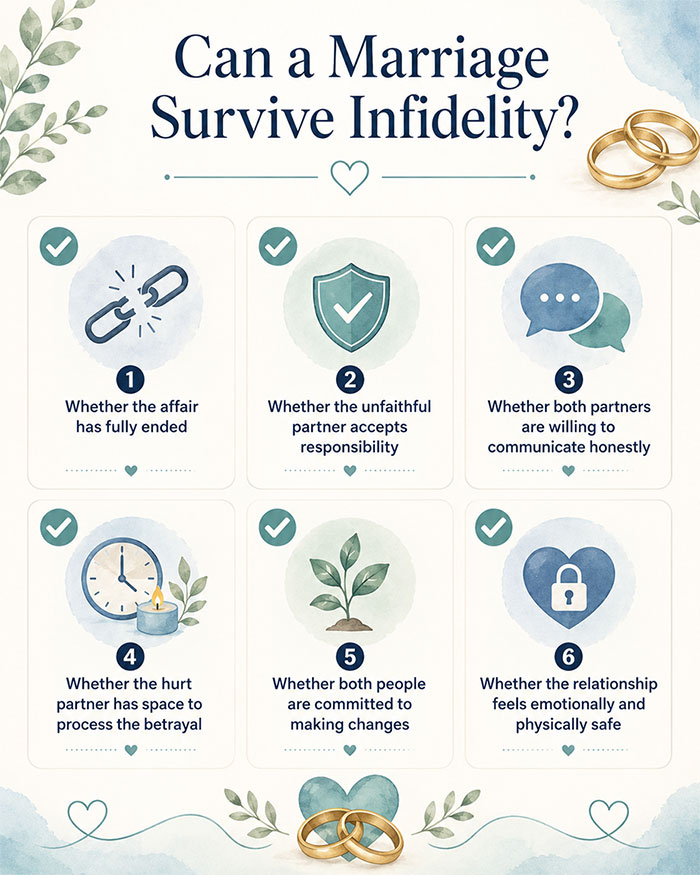
The outcome often depends on several factors, including:
✓ Whether the affair has fully ended
✓ Whether the unfaithful partner accepts responsibility
✓ Whether both partners are willing to communicate honestly
✓ Whether the hurt partner has space to process the betrayal
✓ Whether both people are committed to making changes
✓ Whether the relationship feels emotionally and physically safe
Infidelity can deeply affect trust, identity, security, and emotional connection. Recovery is rarely immediate, but meaningful progress may be possible when both partners are willing to participate.
What Counts as Infidelity?
Infidelity can take different forms.
It is not always limited to a physical affair.
| Type of Infidelity | What It May Involve |
| Physical infidelity | Sexual or intimate contact outside the relationship |
| Emotional infidelity | A secret emotional bond with another person |
| Online infidelity | Sexual messages, dating apps, or secret online relationships |
| Financial infidelity | Hidden spending, accounts, debts, or financial decisions |
| Repeated secrecy | Ongoing deception that violates relationship boundaries |
What feels like betrayal can vary between couples.
A marriage therapist can help clarify what happened, how each partner defines trust, and what boundaries were crossed.
How Infidelity Affects the Hurt Partner
Discovering infidelity can create an intense emotional response.
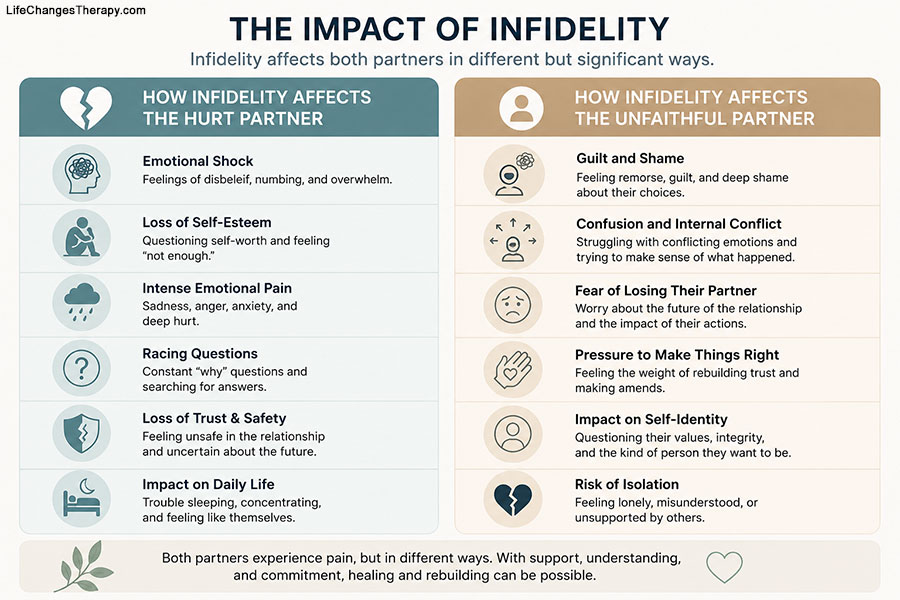
The hurt partner may experience:
- Shock
- Anger
- Sadness
- Anxiety
- Shame
- Confusion
- Difficulty sleeping
- Constant questioning
- Loss of confidence
- Fear that the betrayal will happen again
Some people repeatedly replay details in their minds or feel compelled to search for more information.
These reactions are often attempts to understand what happened and regain a sense of safety.
How Infidelity Affects the Unfaithful Partner
The partner who was unfaithful may also experience difficult emotions.
These may include:
- Guilt
- Shame
- Fear of losing the relationship
- Defensiveness
- Confusion
- Frustration with repeated questions
- Uncertainty about how to repair the damage
Taking responsibility does not mean remaining trapped in shame.
It means understanding the impact of the betrayal and participating honestly in the repair process.
What Is Marriage Counselling for Infidelity?
Marriage counselling for infidelity is a structured form of couples therapy focused on betrayal, trust, communication, and relationship decisions.
The therapist helps both partners discuss what happened in a way that reduces further emotional damage.
The goal is not to force the couple to stay together.
Instead, therapy may help them:
✓ Understand the emotional impact of the affair
✓ Establish immediate boundaries
✓ Improve communication
✓ Reduce destructive arguments
✓ Explore why the relationship became vulnerable
✓ Rebuild trust through consistent behaviour
✓ Decide whether reconciliation is realistic
✓ Separate more respectfully when necessary
What Happens During Infidelity Counselling?
The process usually happens in stages.
Stage 1: Creating Emotional Stability
The first priority is often reducing chaos.
The couple may be dealing with repeated arguments, emotional withdrawal, sleep disruption, or uncertainty about whether the affair has ended.
Early sessions may focus on:
✓ Confirming whether contact with the other person has stopped
✓ Creating boundaries around communication
✓ Reducing harmful conflict
✓ Helping each partner express immediate concerns
✓ Supporting emotional safety
Major long-term decisions may be difficult while emotions are extremely intense.
Stabilization gives both partners room to think more clearly.
Stage 2: Understanding What Happened
Once the situation is more stable, therapy may explore the circumstances surrounding the infidelity.
This is not about blaming the hurt partner for the affair.
The person who chose infidelity remains responsible for that choice.
However, understanding the wider relationship context may help the couple identify:
- Emotional distance
- Unresolved resentment
- Avoided conflict
- Poor boundaries
- Individual stress
- Need for attention or validation
- Communication problems
- Personal vulnerabilities
Understanding is different from excusing.
The purpose is to reduce the chance of repeating the same patterns.
Stage 3: Rebuilding Trust
Trust is not restored through one apology.
It is rebuilt through consistent behaviour over time.
| Trust-Building Action | Why It Matters |
| Honest answers | Reduces uncertainty and secrecy |
| Consistent behaviour | Shows that change is reliable |
| Clear boundaries | Creates emotional safety |
| Accountability | Demonstrates responsibility |
| Patience | Allows the hurt partner time to heal |
| Follow-through | Matches words with actions |
The hurt partner may need reassurance more than once.
The unfaithful partner may need to tolerate difficult conversations without becoming defensive or demanding quick forgiveness.
Stage 4: Rebuilding the Relationship
If both partners choose reconciliation, therapy may move toward creating a healthier relationship rather than simply returning to the old one.
This may involve:
✓ Improving emotional intimacy
✓ Learning healthier conflict-resolution skills
✓ Discussing unmet needs
✓ Creating clearer boundaries
✓ Rebuilding physical connection gradually
✓ Developing shared goals
✓ Establishing new relationship expectations
The goal is not to forget the betrayal.
It is to create a relationship in which both partners feel safer, more honest, and more connected.
Can Trust Fully Return After Infidelity?
Trust may return, but it may not look exactly the same as it did before.
Before infidelity, trust may have been automatic.
After betrayal, trust often becomes more intentional.
It may be based on:
- Consistent honesty
- Clear communication
- Reliable behaviour
- Respect for boundaries
- Willingness to discuss difficult feelings
- Shared responsibility for the relationship
Some couples eventually report a stronger understanding of one another.
Others find that trust improves but remains sensitive in certain situations.
There is no universal timeline.
Signs Trust May Be Rebuilding
Progress may be happening when:
✓ Conversations become less explosive
✓ Questions can be discussed more openly
✓ The unfaithful partner responds with accountability
✓ Secrecy decreases
✓ Agreements are consistently followed
✓ Emotional closeness begins to return
✓ Both partners feel more hopeful
✓ Conflict becomes more respectful
Progress is not always linear.
A reminder, date, location, message, or unexpected event may temporarily bring the pain back.
That does not automatically mean therapy is failing.
Signs Reconciliation May Be Difficult
Marriage counselling may be less effective when:
✗ The affair is continuing
✗ Important information is still being hidden
✗ The unfaithful partner refuses responsibility
✗ The hurt partner is pressured to forgive quickly
✗ There is repeated deception
✗ One partner is unwilling to participate
✗ Emotional or physical abuse is present
Therapy requires honesty and safety.
When one partner continues harmful behaviour, rebuilding trust becomes extremely difficult.
Should Every Detail Be Disclosed?
Couples often struggle with how much information should be shared.
Some details may be necessary to understand the nature of the betrayal and establish honesty.
Other highly graphic details may cause additional distress without helping recovery.
A therapist can help the couple decide:
- Which questions need clear answers
- Which details support informed decisions
- How information should be discussed
- How to prevent repeated questioning from becoming emotionally overwhelming
The goal is transparency without causing unnecessary harm.
Is Forgiveness Required?
Forgiveness cannot be forced.
It is also not the same as forgetting, excusing, or pretending the affair did not matter.
For some people, forgiveness develops slowly.
For others, the goal may be acceptance rather than forgiveness.
Therapy can help the hurt partner decide what forgiveness means personally and whether it is part of their healing process.
The unfaithful partner should not demand forgiveness as proof that the relationship is improving.
How Long Does Infidelity Counselling Take?
There is no fixed timeline.
The length of counselling may depend on:
✓ How long the affair lasted
✓ Whether the betrayal happened once or repeatedly
✓ Whether the full truth has been disclosed
✓ The couple’s relationship history
✓ Each partner’s emotional readiness
✓ The level of commitment to change
✓ Whether individual concerns also need attention
Some couples begin noticing improved communication within several sessions.
Rebuilding deeper trust may take much longer.
Can Counselling Help If We Are Unsure About Staying Together?
Yes.
Couples do not need to decide immediately whether they will remain together.
Therapy can help both partners slow the process down and explore:
- Whether reconciliation is realistic
- What each person would need to stay
- Whether trust can be rebuilt
- Whether the relationship remains emotionally safe
- Whether separation may be healthier
Sometimes the goal of counselling is not reconciliation.
It may be clarity.
Can Individual Therapy Help Too?
Yes.
Individual therapy may be useful alongside couples counselling.
The hurt partner may need support for anxiety, self-esteem, grief, or emotional regulation.
The unfaithful partner may need to explore personal patterns, boundaries, avoidance, or decision-making.
Individual therapy can support personal healing, but it should not be used to avoid honest work within the relationship.
Benefits of Marriage Counselling After Infidelity
| Benefit | How It May Help |
| Structured communication | Reduces destructive arguments |
| Greater emotional understanding | Helps both partners express deeper feelings |
| Clearer boundaries | Supports safety and accountability |
| Improved decision-making | Helps the couple evaluate the future |
| Trust-building strategies | Turns apologies into consistent action |
| Relationship repair | Creates healthier communication and connection |
Common Myths About Infidelity Counselling
Myth: If the affair happened, the marriage is already over.
Reality: Some relationships end, but others recover with honesty, accountability, and professional support.
Myth: The hurt partner should forgive quickly.
Reality: Healing takes time. Pressure to forgive can make the hurt partner feel dismissed.
Myth: Talking about the affair makes things worse.
Reality: Avoiding the subject often leaves questions and resentment unresolved. Structured conversations may support healing.
Myth: The affair is always caused by problems in the marriage.
Reality: Relationship difficulties may provide context, but the person who chose infidelity remains responsible for that choice.
Myth: Trust will return if both partners simply move on.
Reality: Trust usually requires consistent action, transparency, and time.
Why Choose Life Changes Therapy?
Life Changes Therapy provides supportive marriage counselling in Mississauga for couples dealing with infidelity, broken trust, communication difficulties, and emotional distance.
The counselling process is designed to help both partners:
✓ Discuss the betrayal safely
✓ Understand emotional reactions
✓ Reduce harmful conflict
✓ Create clearer boundaries
✓ Rebuild trust where possible
✓ Make informed decisions about the relationship
Therapy is personalized to the couple’s circumstances and goals.
The focus is not on taking sides or forcing reconciliation. It is on creating a respectful environment where both partners can speak honestly and determine the healthiest path forward.
Final Thoughts
Trust can sometimes return after infidelity, but it usually returns slowly.
The process requires more than promises.
It requires honesty, accountability, patience, emotional safety, and consistent behaviour.
Marriage counselling for infidelity can help couples understand what happened, manage the emotional impact, rebuild communication, and decide whether they want to create a new relationship together.
Recovery does not mean pretending the betrayal never happened.
It means learning whether healing is possible and what both partners are willing to do next.
Frequently Asked Questions
Can marriage counselling help after infidelity?
Yes. Marriage counselling can help couples manage the emotional impact of infidelity, improve communication, rebuild trust, establish boundaries, and decide whether reconciliation is possible.
How long does it take to rebuild trust after an affair?
There is no fixed timeline. Rebuilding trust may take months or longer depending on the nature of the betrayal, honesty between partners, consistency of change, and each person’s emotional readiness.
Does the unfaithful partner need to answer every question?
Honest answers are important, but not every graphic detail is necessarily helpful. A therapist can guide the couple in deciding which information supports healing and informed decision-making.
Can a marriage become stronger after infidelity?
Some couples develop stronger communication, clearer boundaries, and greater emotional awareness after working through infidelity. However, this requires sustained effort from both partners and is not guaranteed.
Does Life Changes Therapy provide marriage counselling for infidelity in Mississauga?
Yes. Life Changes Therapy provides marriage counselling in Mississauga for couples experiencing infidelity, broken trust, communication problems, and relationship uncertainty.