Anxiety therapy helps individuals better manage anxiety, which is a natural response to stress, uncertainty, change, and perceived danger. Most people experience anxious thoughts before an important appointment, difficult conversation, major decision, or unfamiliar situation.
However, anxiety may require professional support when it becomes persistent, difficult to control, or disruptive to everyday life.
You may benefit from anxiety therapy when worry, fear, physical tension, avoidance, or racing thoughts begin affecting your sleep, relationships, work, school, confidence, or ability to complete normal activities.
You do not need to wait until anxiety becomes overwhelming before speaking with a therapist. Anxiety therapy can help you understand your symptoms, identify patterns that keep anxiety active, and develop healthier ways to respond.
Do I Need Anxiety Therapy?
You may need anxiety therapy when anxious thoughts or physical symptoms continue even when there is no immediate danger.
Consider speaking with an anxiety therapist when:
✓ You worry excessively about several areas of your life
✓ Your anxious thoughts feel difficult to control
✓ Anxiety interferes with your sleep or concentration
✓ You avoid people, places, activities, or responsibilities
✓ Physical anxiety symptoms happen regularly
✓ You repeatedly seek reassurance from other people
✓ Anxiety affects your relationships or work performance
✓ You no longer feel like yourself
Experiencing occasional anxiety does not necessarily mean that you need therapy. The frequency, intensity, duration, and effect of your symptoms are important.
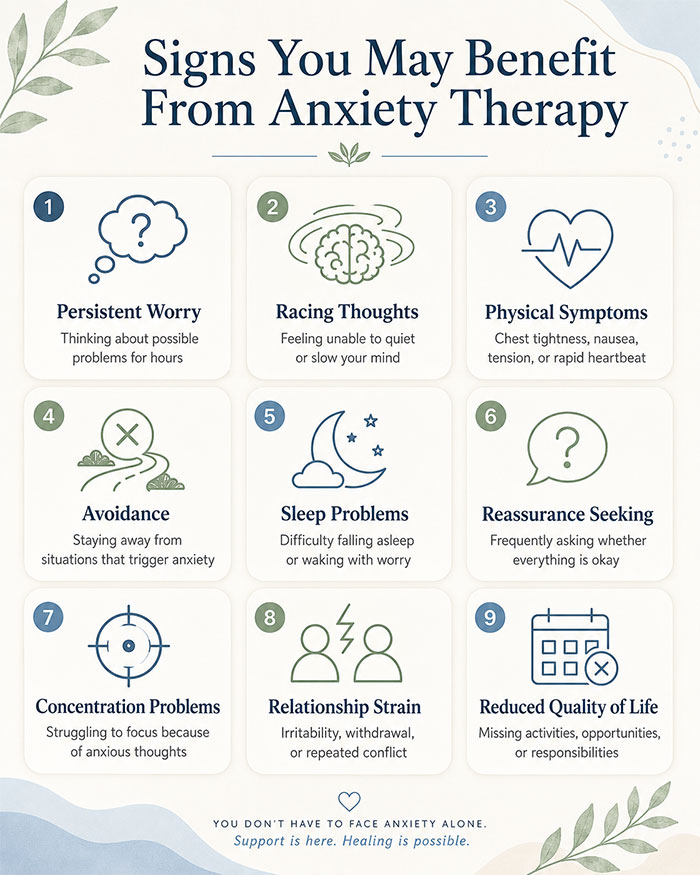
Signs You May Benefit From Anxiety Therapy
| Anxiety Sign | What It May Look Like |
| Persistent worry | Thinking about possible problems for hours |
| Racing thoughts | Feeling unable to quiet or slow your mind |
| Physical symptoms | Chest tightness, nausea, tension, or a rapid heartbeat |
| Avoidance | Staying away from situations that trigger anxiety |
| Sleep problems | Difficulty falling asleep or waking with worry |
| Reassurance seeking | Frequently asking whether everything is okay |
| Concentration problems | Struggling to focus because of anxious thoughts |
| Relationship strain | Irritability, withdrawal, or repeated conflict |
| Reduced quality of life | Missing activities, opportunities, or responsibilities |
A person can appear calm, capable, and productive while experiencing significant anxiety internally. You do not have to be visibly distressed for your symptoms to deserve attention.
When Does Normal Anxiety Become a Problem?
Normal anxiety usually has a recognizable cause. It may increase before a stressful situation and gradually decrease once the situation passes.
Problematic anxiety can continue long after the stressful event has ended. It may also appear without a clear reason or feel much stronger than the situation seems to require.
Anxiety may be becoming a problem when:
- It occurs on most days
- It has continued for several weeks or months
- It feels difficult to manage independently
- It causes significant emotional or physical discomfort
- It prevents you from doing things that matter to you
- It continues despite preparation or reassurance
- It limits your ability to enjoy everyday life
The question is not only, “How anxious do I feel?” It is also, “How much is anxiety influencing the way I live?”
You Cannot Stop Worrying
One of the most common signs that you may benefit from anxiety therapy is persistent worry.
You may repeatedly think about:
- Your health
- Your relationships
- Your finances
- Your work or school performance
- Your family’s safety
- Past conversations
- Future mistakes
- Situations you cannot control
The worry may continue even after you have tried to solve the problem or received reassurance.
Anxiety therapy can help you recognize the difference between productive problem-solving and repetitive worry that increases distress without creating a solution.
Anxiety Is Causing Physical Symptoms
Anxiety activates the body’s stress response. This can create real physical symptoms, even when there is no immediate physical threat.
Common physical signs of anxiety include:
✓ A rapid heartbeat
✓ Tightness in the chest
✓ Shortness of breath
✓ Muscle tension
✓ Headaches
✓ Dizziness
✓ Sweating or shaking
✓ Nausea or digestive discomfort
✓ Fatigue
✓ Difficulty sleeping
These symptoms can sometimes increase anxiety because the person begins worrying that something is physically wrong.
New, severe, or unexplained physical symptoms should also be discussed with an appropriate medical professional. A therapist can address anxiety-related patterns, while a medical assessment can help rule out other possible causes.
You Are Avoiding Situations Because of Anxiety
Avoidance is one of the clearest signs that anxiety is beginning to control your daily life.
You may avoid:
- Social gatherings
- Driving
- Public transportation
- Work presentations
- Medical appointments
- Difficult conversations
- Crowded places
- Unfamiliar environments
- Activities where you might make a mistake
- Situations where leaving may be difficult
Avoidance often provides immediate relief. However, it can strengthen anxiety over time by teaching the brain that the avoided situation must be dangerous.
As avoidance continues, your world may become increasingly restricted.
Anxiety therapy can help you approach feared situations gradually while developing skills to manage the discomfort safely.
Anxiety Is Affecting Your Sleep
Anxiety and sleep problems often reinforce one another.
You may feel exhausted during the day but become mentally alert as soon as you try to sleep. Your mind may replay conversations, review responsibilities, or imagine everything that could go wrong.
Anxiety-related sleep problems can include:
- Difficulty falling asleep
- Waking throughout the night
- Waking earlier than intended
- Having anxious or distressing dreams
- Feeling tense before bedtime
- Checking the time repeatedly
- Feeling tired even after sleeping
Poor sleep can make emotional regulation, concentration, and decision-making more difficult. This may cause anxiety to feel even more intense the following day.
You Constantly Need Reassurance
Seeking occasional reassurance is normal. Repeated reassurance seeking may be a sign of an anxiety cycle.
You may frequently ask:
- “Are you sure everything is okay?”
- “Do you think they are upset with me?”
- “What if I made the wrong choice?”
- “Do you think this symptom is serious?”
- “Are you sure I did not make a mistake?”
Reassurance may provide temporary relief, but the anxiety often returns. You may then need to ask again or find another source of reassurance.
Anxiety therapy can help you build confidence in your ability to tolerate uncertainty without repeatedly checking, asking, or reviewing.
Anxiety Is Affecting Your Relationships
Anxiety does not only affect the person experiencing it. It can also influence communication, connection, trust, and intimacy.
Relationship effects may include:
✓ Frequently seeking reassurance from a partner
✓ Becoming irritable when overwhelmed
✓ Withdrawing from conversations or activities
✓ Assuming another person is angry or losing interest
✓ Avoiding conflict because it feels unsafe
✓ Trying to control plans to reduce uncertainty
✓ Depending heavily on someone else for emotional comfort
Loved ones may want to help but may not know how to respond. They can become caught between offering support and unintentionally reinforcing anxious patterns.
Therapy can help you communicate your needs more clearly while building greater confidence in your ability to manage difficult emotions.
You Experience Panic Attacks
A panic attack is a sudden period of intense fear or discomfort that may include physical and emotional symptoms.
These symptoms can include:
- A pounding or racing heartbeat
- Shortness of breath
- Chest discomfort
- Shaking
- Dizziness
- Sweating
- Nausea
- Feeling detached or unreal
- Fear of losing control
- Fear that something terrible is happening
After a panic attack, some people become highly focused on preventing another one. They may avoid certain locations, activities, sensations, or situations.
Anxiety therapy can help you understand panic symptoms, reduce fear of the physical sensations, and develop strategies for responding more effectively.
Anxiety Is Reducing Your Quality of Life
You do not have to be in a crisis to seek anxiety therapy.
Professional support may be appropriate when anxiety prevents you from living the way you would like to live.
This may include:
✗ Turning down opportunities because of fear
✗ Avoiding meaningful relationships
✗ Missing work, school, or appointments
✗ Giving up hobbies or social activities
✗ Spending hours preparing for simple tasks
✗ Feeling unable to enjoy positive experiences
✗ Making decisions primarily to avoid discomfort
When anxiety begins making important decisions for you, it may be time to speak with a therapist.
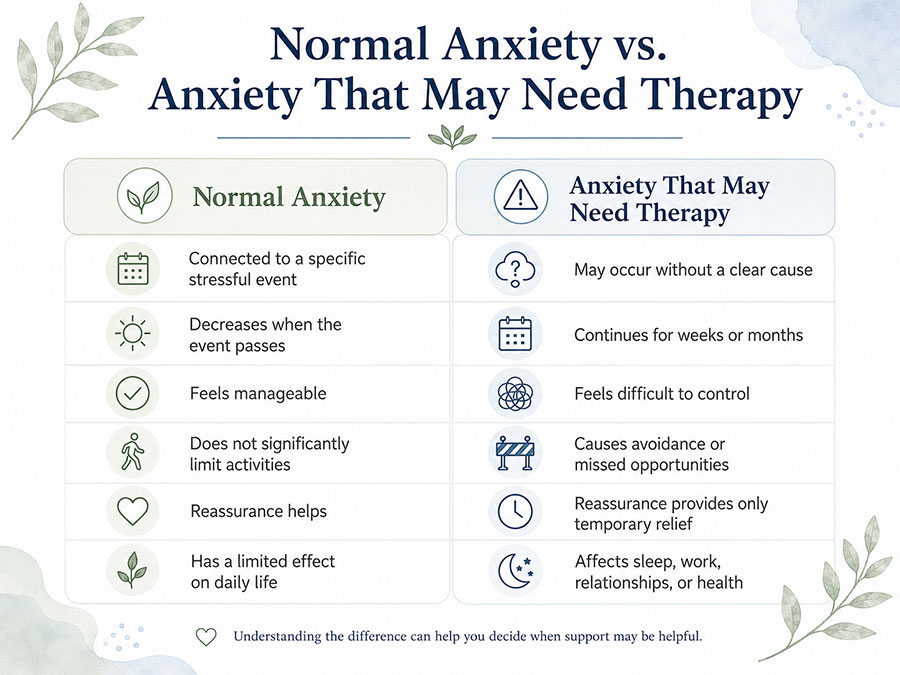
Normal Anxiety vs. Anxiety That May Need Therapy
| Normal Anxiety | Anxiety That May Benefit From Therapy |
| Connected to a specific stressful event | May occur without a clear cause |
| Decreases when the event passes | Continues for weeks or months |
| Feels manageable | Feels difficult to control |
| Does not significantly limit activities | Causes avoidance or missed opportunities |
| Reassurance helps | Reassurance provides only temporary relief |
| Has a limited effect on daily life | Affects sleep, work, relationships, or health |
The presence of anxiety does not automatically mean something is seriously wrong. Therapy is a resource for understanding your experience and improving how you respond to it.
How Does Anxiety Therapy Help?
Anxiety therapy provides a supportive environment where you can explore your worries without judgment.
Depending on your needs, therapy may help you:
✓ Identify anxiety triggers
✓ Understand patterns behind anxious thoughts
✓ Challenge unrealistic or unhelpful beliefs
✓ Reduce avoidance behaviours
✓ Improve emotional regulation
✓ Develop grounding and relaxation skills
✓ Respond differently to uncertainty
✓ Strengthen communication and boundaries
✓ Build confidence in difficult situations
✓ Create healthier coping strategies
The goal of anxiety therapy is not to eliminate every uncomfortable emotion. Some anxiety is a normal part of life.
The goal is to reduce the control anxiety has over your thoughts, decisions, relationships, and activities.
How Long Should I Wait Before Getting Help?
There is no required amount of time you must wait before contacting an anxiety therapist.
It may be helpful to seek support when:
- Your symptoms are becoming more frequent
- Your coping strategies are no longer working
- Anxiety is affecting several areas of your life
- You are beginning to avoid important situations
- Your symptoms have continued for several weeks
- You feel emotionally exhausted
- You want help before the anxiety becomes more severe
Seeking therapy early can make it easier to address anxious patterns before they become deeply established.
Get Support for Anxiety in Mississauga
Living with persistent anxiety can be mentally and physically exhausting. You may understand that your fears are unlikely while still feeling unable to stop the anxious response.
Life Changes Therapy provides anxiety therapy in Mississauga for individuals who want to better understand their symptoms, develop effective coping strategies, and feel more confident in everyday life.
Therapy offers a private and supportive space where you can discuss what you are experiencing and work toward meaningful, manageable change.
Conclusion: Do You Need Anxiety Therapy?
You may benefit from anxiety therapy when worry, fear, physical symptoms, avoidance, or racing thoughts begin interfering with your daily life.
You do not need to wait for anxiety to become unbearable. Therapy can be helpful whether your symptoms are recent, long-standing, mild, or significantly disruptive.
Recognizing that anxiety is affecting you is not a personal failure. It is an opportunity to receive support, develop new skills, and begin creating a healthier relationship with your thoughts and emotions.
Contact Life Changes Therapy to learn more about anxiety therapy in Mississauga and determine whether professional support may be right for you.
Frequently Asked Questions About Anxiety Therapy
How do I know whether my anxiety is serious enough for therapy?
Anxiety may be serious enough for therapy when it feels difficult to control or begins affecting your sleep, relationships, work, school, health, or daily activities. You do not need to wait until your symptoms become severe before seeking support.
Can anxiety therapy help with physical symptoms?
Anxiety therapy can help reduce physical symptoms by addressing the thoughts, triggers, behaviours, and stress responses connected to anxiety. New or unexplained physical symptoms should also be discussed with an appropriate medical professional.
What happens during the first anxiety therapy session?
The first session usually focuses on understanding your concerns, symptoms, experiences, and goals. The therapist may ask when the anxiety began, what makes it better or worse, and how it affects different areas of your life.
Can I have anxiety even when my life is going well?
Yes. Anxiety can occur even when there is no obvious crisis or major external problem. It may be influenced by past experiences, ongoing stress, learned patterns, uncertainty, physical health, or several contributing factors.
How long does anxiety therapy take?
The length of anxiety therapy varies according to your symptoms, goals, circumstances, and progress. Some people notice improvements after several sessions, while others benefit from longer-term support for more established anxiety patterns.